The team is proud to announce the release of Linux Mint 8 “Helena” LXDE Community Edition.

Quick steps:

Introduction to Linux Mint 8 LXDE:

Based on Linux Mint 8 Main Edition, Linux 2.6.31, Openbox 3.4.7.2, PCManFM 0.5.2, and Xorg 7.4, Linux Mint 8 LXDE Edition features a complete and familiar desktop experience while being low on resource usage and is suitable for a good variety of older hardware.

For a detailed overview of the new features and improvements included in Linux Mint 8 LXDE, please read “What’s new in Helena LXDE?“.

Benchmark:

Here’s a quick benchmark comparing this edition to the Fluxbox and Xfce editions of Linux Mint. All 3 editions were tested on the same hardware (a computer with 384MB RAM).

RAM usage at idle:

  • Fluxbox: 131MB
  • LXDE: 141MB
  • Xfce: 154MB

Maximum RAM usage during the installation:

  • Fluxbox: 235MB
  • LXDE: 246MB
  • Xfce: 262MB

Boot time from Grub to the login manager:

  • Fluxbox: 31.16 seconds
  • LXDE: 26.79 seconds
  • Xfce: 26.46 seconds

Boot time from the login manager to the desktop:

  • Fluxbox: 3.32 seconds
  • LXDE: 3.77 seconds
  • Xfce: 9.63 seconds

System requirements:

  • x86 processor
  • 256 MB of system memory (RAM)
  • 3 GB of disk space for installation
  • Graphics card capable of 800×600 resolution
  • CD-ROM drive or USB port

Important information and known issues:

For a complete list of known issues read the release notes.

Download Linux Mint 8 LXDE:

This edition is available via HTTP and torrent from the download page.

Enjoy!

Have a lot of fun with this edition and let us know what you think. Reviews will be answered and your feedback will be used to improve the distribution before the next release. We hope you enjoy this release as much as we enjoyed making it and we wish you a very nice experience with Linux Mint.

In this blog post, I’ll only go through the features that are developed specifically for Linux Mint.

System

  • USB-Creator will be added to the default software selection.
  • apturl will be added to the system.
  • In memory of Husse, a new fortune database gathering his best quotes will be added to the pool of random messages that appear when you open a terminal.
  • apt is getting three more commands: “apt hold <package>”, “apt unhold <package>” and “apt held”. These commands are shortcuts to “echo <package> hold | dpkg –set-selections”, “echo <package> install | dpkg –set-selections” and “dpkg –get-selections | grep hold”.

Menu


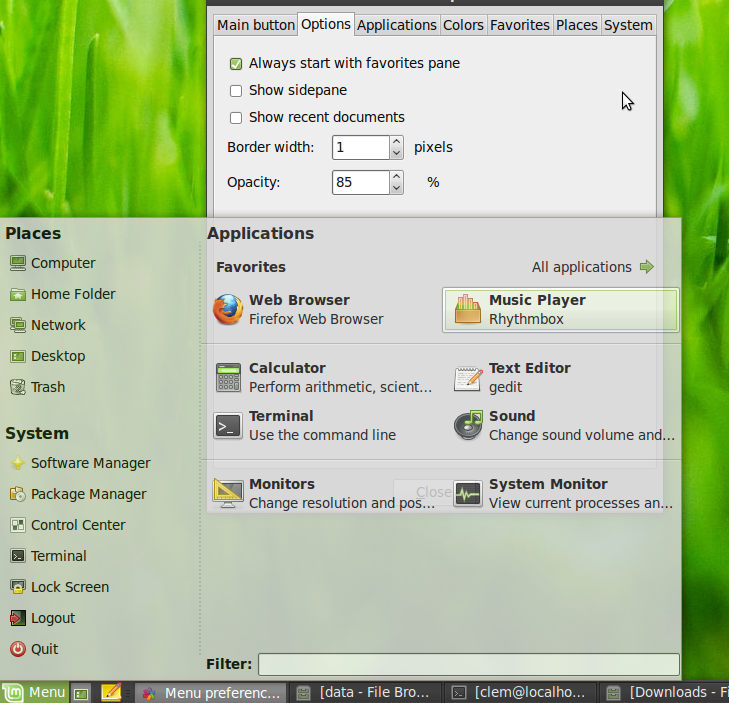
  • You can now edit items directly from the menu. If you want to change the name, the icon, the description or even the command for a particular application, just right-click on it and select “Edit Properties”.
  • If your graphics card allows it (you need compositing for this to work), you can change the transparency of the menu. Go in the preferences, select the “Options” tab and change the percentage of opacity.
  • There are two new context menu item to let you easily add shortcuts to the panel or the desktop.
  • An option which you can enabled to “always start with the favourites”.

Update Manager


  • The brown lock icons are gone. We’re replacing them with white shields. They look better and their meaning is a little more obvious.
  • You’ll only see an error icon when something is actually wrong, for instance if your software sources are malformed. If the Update Manager isn’t able to assess the status of your updates (say there’s no connection to the Internet, or another APT application  is running) it won’t consider it an error. In simple words, you won’t be seeing a broken lock or an error icon unless something needs fixing.

Community Website

Although it’s not part of the Linux Mint 9 release itself, it’s development and its announcement will be in sync with Isadora. It will also replace the current Software Portal and act as the Web equivalent to the new Software Manager.

  • You can submit, comment and vote ideas to improve the distribution.
  • The Hardware Database shows you what hardware works out the box with Linux Mint. It’s particularly useful if you want to go shopping and you’re wondering about compatibility. If you’ve got problems with a particular device, the Hardware Database also shows you which other users own that device, how did they make it work and how you can contact them if needed.
  • The Software Portal shows all the packages available in the repositories. You can browse them by categories, rate them, review them, and even submit a screenshot.

Software Manager

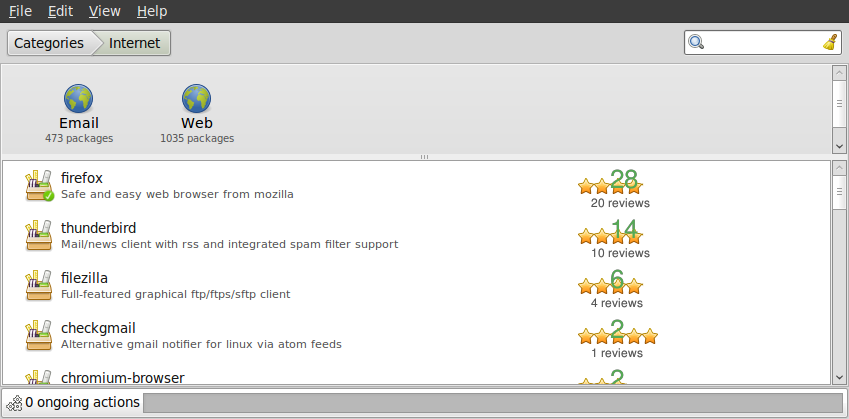
The Software Manager, mintinstall, was rewritten from scratch. It features the best ideas from the original mintinstall, Gnome App-Install and the new Ubuntu Software Center. It’s also much more efficient than the previous version, handling 30,000+ packages and asynchronous installation/removal of applications in less than 1,000 lines of code.

  • It’s package-centric and it now features all the packages available on your system. That’s about 30,000 packages to choose from, compared to around 300 in the current version of mintinstall.
  • It uses and monitors the APT daemon, so when you click on the “install” button it just queues your action and processes it in the background. At any time you can see all on-going actions, their progress and you can even cancel them.
  • It’s completely asynchronous and independent from APT. Say you’ve decided to install 20 applications, your queue is full of progress bars and it’s going to take time before it’s all finished. Well, nothing is stopping you from closing the Software Manager. The actions will go on in the background. And if you ever decide to launch the Software Manager again, just to see what’s going on and what hasn’t been installed yet, you can. The queue will appear and inform you of the remaining ongoing processes.
  • The GUI is radically different. It’s inspired from the Ubuntu Software Center and it uses the Webkit engine to render parts of the interface in HTML/CSS. Everything is single-click. You can browse categories, applications, screenshots and even websites from the comfort of a single window.

In-development

All the improvements above are will be part of Linux Mint 9. Most of them are implemented and those which are not will be added very soon. We’re also planning on some other improvements, which, if everything goes according to schedule, should make it into Linux Mint 9 as well:

  • The ability to review applications directly from the Software Manager
  • Lesser and better suggestions in the Menu
  • Improved layout in the Menu
  • Brand new artwork (we’re experimenting with metal-looking themes and there are improvements planned for the Shiki theme as well)
  • New modules in the community website: blog, tutorials, FAQ

Upstream

It’s too soon to talk about what’s going on upstream but you can expect faster boot, the release will be an LTS release, there’s going to be many little improvements in Gnome itself and of course we’re getting a new kernel. I saw the controversy about the position of the window buttons in Ubuntu 10.04. There’s no plan to change anything in Linux Mint, we’re happy with the buttons staying on the right-hand side and away from the File, Edit, View menus.

3 new modules were made available for the Community website at http://community.linuxmint.com

Messaging

If you’re logged in, you can now send a message to other people. They will receive a notification by email. They can reply to you, in which case you’ll get a notification as well. There’s a new “inbox” for your messages and an indication of how many unread messages you have on the left hand side of the website, just beside your avatar.

From your inbox you can also click on “View Outbox” to see the status of the messages you sent. Now, don’t think of this as your usual “sent mail”. This is not an email system. After you send a message, it becomes visible to your recipient in his/her inbox, and to you in your outbox. The title appears in bold characters until your recipient reads the message, and it disappears both from the recipient’s inbox and your outbox once deleted by the recipient.

The reason this behaves like this is to minimise the resources used by the module and to give you the ability to check if your message was read by the person you sent it to.

Notifications

You’ll receive notifications when something requires your attention or when something might be of interest to you. Notifications are not urgent and they do not require an answer from you, so they don’t appear in your “inbox” and you don’t get emails about them.

At the moment, only one module uses notifications: the Idea module. If you find an idea interesting and you’d like to follow its development, you can click on the “Subscribe” button on the top-right corner of the page. You’ll then receive notifications when this idea is edited by its author, when a user comments the idea or when an administrator changes its status.

A visual indicator on the left side of the page, beside your inbox and your avatar shows you if you’ve got unread notifications. Clicking on it brings you to your notifications box where you can see all your notifications. Note that notifications relate to a particular item (for instance, a particular idea) and that accessing that item, whether it is from a notification or by other means, automatically deletes all notifications you have about this item.

Friends

You can add people to your friends list by clicking the “Add as friend” button on their profile. And you can remove them from it either from their profile or directly from your friends list (click on My Places -> My Friends to access your friends list).

Note that people get notified by email when you add them as a friend.

At the moment, being friends on the Community site doesn’t mean much. It just gives you quick access to them when you want to compose a message. Friends list will become more important as we introduce new modules in the future, especially in regards to social networking, groups and rankings.

Other changes

The website is now accessible to visitors in read-only mode. This means you can point to ideas, hardware, software, users profiles… to people who aren’t registered on the website.

The layout of the profile page was changed so you can now look at someone’s profile and see his ideas, his hardware, his favourite software, his friends… all on the same page.

What’s coming next?

I personally would like to code the blog module next. This module’s purpose is to let you have your own blog on the website, to let people subscribe to it, comment and vote your articles and for them to have dynamic feeds of their subscribed blogs. I’m also planning on adding tutorial and FAQ modules and hopefully to come up with a way for users to easily share their knowledge and to publish howtos.